Thursday, October 23, 2008

Dynamic IT

CIO Magazine just surveyed 173 IT business leaders to gauge what the common attitudes are towards cloud computing in the enterprise. 58 percent indicated that cloud computing will dramatically change the IT business, and 47 percent said they are already using it. On the other side, 18 percent think that cloud computing is a fad. survey

CIO used the broad definition of cloud computing: "a style of computing where massively scalable IT-related capabilities are provided 'as a service' using Internet technologies to multiple external customers". Other terms used are "on-demand services", "cloud services", "Software-as-a-Service".

The survey confirmed that cloud computing is a solution to the need for flexibility in IT resource management. IT needs flexibility and cost savings, but is unwilling to jump in with both feet until some lingering concerns are addressed: the top concern being security.

Cloud computing will be used in many pilot/proof-of-concept projects by the incumbents, and it will be experimented with as full blown business models by a growing cadre of start-ups. We have described this many times in this blog that the cloud computing model will be driven by the small and medium business segment because they value cost savings over security or SLAs. And typically with technologies that offer dramatic cost savings, when successful, there will be carnage among the companies that are holding on too tightly to old fashioned business models.

Monday, October 6, 2008

Bluehouse is in public beta

IBM announced cloud computing applications at Lotusphere in January of this year. A service called Bluehouse is a web-delivered social networking and collaboration service targeted to the SMB market. Bluehouse enables people to share documents, projects, and contacts, and offers online conferencing features as well. The Bluehouse service has gone into public beta.

Willy Chiu, VP at IBM of High Performance On-Demand Solutions stated: "We are moving our clients, the industry and even IBM itself to have a mixture of data and applications that live in the data centre and in the cloud." IBM's approach is to expand its cloud computing offerings through a 'four-pronged strategy':

  • Deliver a home spun set of cloud services

  • Enable ISVs to design and build cloud services

  • Help customers integrate cloud services into their business

  • Sell cloud computing infrastructure to businesses for on-premise deployments


  • In addition to Bluehouse, IBM is also rolling out a handful of web services. Policy Tester On-Demand will automate the scanning of web content to ensure that it complies with industry legislation, and AppScan On-Demand will scan web applications for security bugs. Sean Poulley, VP of Online Collaboration Services compared the Bluehouse tools to those of Microsoft and Google: "Whereas Microsoft is document centric and Google is email centric, our solution is a mixture of both".

    IBM's $400M investment in a new data center to support this new mid-market SaaS/Cloud Computing services portfolio, brings another large player into the mix. These tools have been a long time coming but with every major brand now on-line, the branding wars can begin.

    Thursday, October 2, 2008

    Windows Server on Amazon EC2

    As soon as I finished yesterday's blog entry, I became aware of a posting by Amazon's CTO, Werner Vogels, where he announces that Microsoft's Windows Server is available on Amazon EC2. According to Vogels: "we can now run the majority of popular software systems in the cloud". So there you have it, both Amazon and Microsoft are/will be offering Windows based applications in the cloud.

    According the Vogels' blog the area that accelerated to adoption of this functionality in Amazon's Elastic Cloud was the entertainment industry due to the wide range of excellent codecs available for Windows. Here is the power of Microsoft's dominance of the client side translating into a huge benefit for cloud adoption. With 20-20 hindsight, the benefit of quality codecs is now obvious, and it will drive very quick adoption of Windows in the Cloud. Content apparently is still king and thus the conduit that delivers it is a critical component. Turns out that Microsoft does have an unfair advantage in the Cloud space.

    Wednesday, October 1, 2008

    Red Dog and Windows Cloud: Microsoft is coming!

    Microsoft's Professional Developers Conference 2008 makes it clear that the nature of software development is radically changing. Microsoft, as no other vendor, has always recognized that the riches of the platform are directly proportional to the number of good developers that work on your platform. As such, Microsoft has always had absolutely fantastic development tools for all aspects and segments of the IT workload. Typically, they are not leading with technologies, but they sure know how to package and disseminate technology when it is ready. The C/C++ compilers are one example, Active Server Pages and C# are others.

    Enter HPC, cluster, and cloud computing: so far this has been driven by Linux mainly because there have been no commercial offerings that solve the problem of pedal-to-the-metal applications that need tight integration with the underlying hardware and operating system services such as memory, communication stacks and I/O.

    For a decade now, Google has blazed the way with web-scale hardware and software infrastructures that are showing their true value. And now Amazon Web Services is also offering an IT-for-rent model that is perfect for web based services. Detrimental to Microsoft, Google and Amazon Web Services do not enable any Microsoft application software, operating systems, development tools, or even web services. Clearly, this is moving momentum away from the Microsoft universe and they have to counter to stay relevant.

    Red Dog appears to be the first salvo across developers bows that Microsoft is coming. Red Dog is Microsoft's IT-for-rent story, as an answer to Linux centric Amazon Web Services. The second shot is dubbed "Windows Cloud". It is a development environment for Internet-based applications, as an answer to Python centric Google Gears.

    Given Microsoft's track record to build very productive development environments that have the hearts of most internal IT shops, I am confident that this will accelerate the Cloud Computing adoption in the mid-market.

    Monday, September 8, 2008

    Google and corporate espionage

    The release of Google's Chrome and the original EULA that was bound to it has opened an interesting debate about how much Google knows about us, and maybe more ominously, how much it knows about your business. I would postulate that Google knows more about your business than you do.

    But first, the EULA flap. The old EULA stated: "You retain copyright and any other rights you already hold in Content which you submit, post or display on or through, the Services. By submitting, posting or displaying the content you give Google a perpetual, irrevocable, worldwide, royalty-free, and non-exclusive license to reproduce, adapt, modify, translate, publish, publicly perform, publicly display, and distribute any Content which you submit, post, or display on or through, the Services."

    Clearly, Google didn't mess this up: they are a big company with a good legal team, so we have to assume that this EULA was deliberately written the way it was. Since Google is a conduit for content, while using this content for its own profit without wanting to pay for it, the EULA makes a lot of sense from Google's perspective. Equally clear is that asking for a "...perpetual, irrevocable, worldwide, royalty-free, and non-exclusive license to reproduce, adapt, modify... publish" is simply unbelievably aggressive leading to a revolt that forced Google to rewrite the EULA.

    For Google's business model to remain viable, it has to extract customer behavior and owning the browser makes that a million times easier. Secondly, searching for information on the internet is essential to today's business, so Google has both customer behavior and customer knowledge searches. This means that it can deduce purpose and effectively learn what you learn. Finally, collective knowledge of your workforce adds a whole new layer of understanding for Google. For example, say you have decided to plan for a new product. The product research your organization is doing will be localized in time and in scope, thus making it easy to filter out of the backdrop of all other searches that your organization is doing. This means that your new product plans will be visible to Google and its clever group of data mining specialists. Their whole job is to mine for data like this so that the Google service can provide you with contextual information that you could use and thus will generate revenue for Google. Google simply needs to know more about your business than you do to continue to generate revenue.

    Google of course is not unique in this respect. Any ad-revenue driven Services will need some spying and semantic inference to yield context to generate revenue. In the consumer space, it appears that people are more willing to part with their preferences in exchange for free access. But the cost for business seems a bit steep, particularly big business, and it comes as a surprise to me that only the media companies have been suing Google. Maybe the Google EULA flap will invigorate the debate on how much data a SaaS or Cloud provider can extract and own and how this needs to be regulated.

    Sunday, August 17, 2008

    IT as a Business: or IaaB

    Whereas SaaS is predominantly a Business Process Outsourcing trend, Cloud Computing is predominantly an IT operation outsourcing trend. IBM and its shift towards services, supported by best-in-class hardware, has been leading this IT outsourcing concept for more than a decade now. However, IBM's main clientele have been large scale, high-availability, high-liability business such as Wall Street, credit card companies, and insurers. The shift created by SaaS as well as Cloud Computing is retargeting the IT supported business process services towards the mid-market where it will proliferate in a very different direction. High-availability is costly, as is high-security. Those are attributes that the mid-market is not going to pay for: they sure haven't paid for it in their own IT infrastructures. That will allow Cloud Computing service providers, such as Amazon Web Services, to provide a truly disruptive technology since it brings a whole new group of customers into the market. A segment that is cummulatively speaking more valuable than the high-end customers of yesteryear.

    Jeff Barr, a Web Services Evangelist at Amazon, just published some interesting data that is supporting the observation that IT operation outsourcing is being leveraged aggressively. It also shows that this switch is happening incredibly quickly. For those in the business, this is not surprising because our customers have been screaming for more performance/capacity for a decade, mostly because the processor vendors such as Intel and IBM have not been able to provide anywhere near the performance improvements required to keep up with the data explosion.
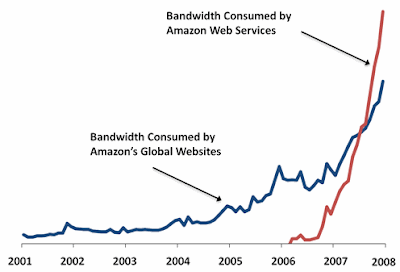


    From Amazon's 4th quarter earnings call, TechCrunch reports that the businesses that are taking advantage of IT operation outsourcing are not just tiny little start-ups:

    "So who are using these services? A high-ranking Amazon executive told me there are 60,000 different customers across the various Amazon Web Services, and most of them are not the startups that are normally associated with on-demand computing. Rather the biggest customers in both number and amount of computing resources consumed are divisions of banks, pharmaceuticals companies and other large corporations who try AWS once for a temporary project, and then get hooked."

    The value that is created by the on-demand capacity inherent to Cloud Computing is the big differentiator here for both startup and established business. For startups the value is inherent to the service, but for the mid-market it is on-demand capacity. To understand this, one must realize that most compute problems are bursty: it takes humans time to formulate experiments and setup the automation, but from that point on compute capacity and performance are the critical path.

    In today's shift towards extracting more value out of operational business data, the mid-market is about to embark on a whole new degree of productivity; Cloud Computing and the pay-as-you-go business model removes IT operation, both CapEx and OpEx, as the limiter for all business: small, medium, and large. With this type of value creation, the switch-over can happen dramatically quickly.

    Saturday, August 16, 2008

    HPC is dead, long live HPC!

    With the advent of web scale computing, genetics, and data mining for business intelligence the need for computer performance is growing exponentially. In a previous post, The Achilles' Heel of SaaS we identified that the processor vendors have been ruefully underdelivering performance so everybody has been forced to build clusters of cooperating servers to support the compute requirements of today's information processing. So now everybody is an HPC consumer.

    If you look at the fortunes of pure HPC providers like Silicon Graphics and Cray it is obvious that corporate America has not been motivated by HPC vendor's marketing messages entailing the goodness of HPC for American's competitiveness. The only outfit that seems to keep these companies afloat is the NSA. This is a trend that has been documented for many years now at the Council on Competitiveness.

    A quick Google trends query shows that just when everybody is becoming an HPC consumer, the term is slowly loosing its luster in favor of more business friendly terms like Cloud Computing and SaaS. SaaS in particular will force the provider to leverage HPC technologies such as clusters and distributed computing.

    You can keep track of these terms here.

    The data also shows that HPC interest and innovation has shifted away from the US to Europe and the far east. Organizations like India's Tata are building and operating world-class HPC installations. Even Sweden is on the top 5 list. It makes a lot of sense for Russia, China, and India to jump on this: they have very little inertia and they understand that moving up into the value chain is the next step of their evolution to play in the global economy.